Place of service codes are a key component of medical billing in the United States. Submitted on the CMS-1500 claim form, these codes indicate the precise location where a service was rendered. To receive appropriate reimbursement and stay compliant with regulations, these codes must be accurate.
CMS maintains a wide range of place-of-service codes, dozens in total. Even an unintentional mistake in selecting a POS code can lead to claim denials or reduced payments.
At RevenueES, we help providers and medical billing firms improve claim submissions, reduce operational overhead, and boost POS code accuracy using intelligent digital systems.
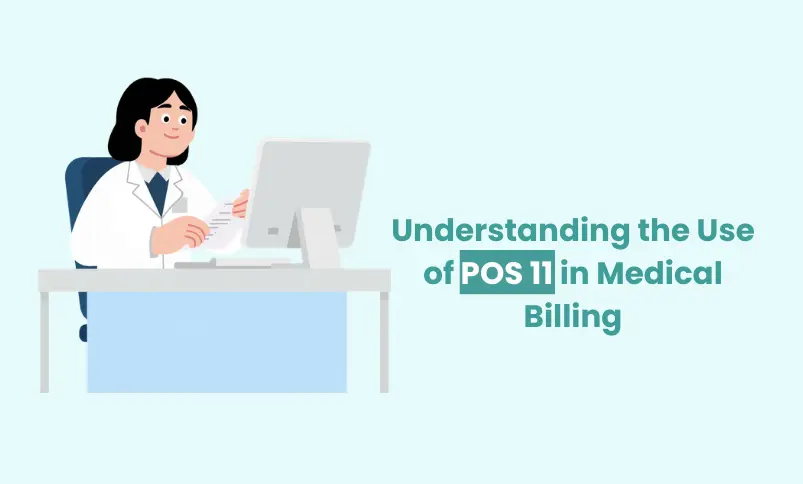
What is Place of Service 11 in Medical Billing?
Place of Service (POS) Code 11 is used for healthcare services delivered in a physician’s office or an independent medical practice. As defined by CMS, this code applies when care takes place in a non-facility office setting, as opposed to a hospital, outpatient department, or institutional facility.
It is commonly used for:
- Follow-ups, consultations, in-person care
- Services in provider-owned clinics
- Also private practice settings
- Correct code ensures accurate reimbursement
- Enables proper claim processing
- Ensures payer compliance requirements
- Routine office visits
When to use POS 11 Service Code
Place of Service Code 11 is used in specific scenarios within medical billing.
This code applies when a patient receives care in a physician’s office or an independently operated clinic setting. It is also appropriate when services are provided at the provider’s designated office.
Additionally, POS 11 should be used when the visit takes place in a non-facility setting rather than a hospital outpatient department. The code is suitable for routine office-based care, including evaluations, consultations, follow-up visits, and minor procedures.
To illustrate, consider a patient who visits a dermatologist’s private office for a skin biopsy or a follow-up appointment. In such a case, POS 11 is generally the correct place of service code to report on the claim.
When not to use POS 11 Service Code?
There are specific situations where you would not use Place of Service Code 11.
- Even if a clinic looks like a regular physician’s office, you should never report Place of Service Code 11 for clinics that are owned and operated by hospitals as outpatient departments.
- When a patient receives treatment at a skilled nursing facility, which corresponds to POS Code 31, or at a nursing home, which corresponds to POS Code 32, you should not report POS 11.
- During delivery of care in an emergency room (POS 23), use POS 23.
- For strictly telemedicine encounters where the patient is at home and the payer specifically requires POS 02 or POS 10, use POS 02 or POS 10 accordingly.
That is the moment when a top medical billing company becomes essential. At RevenueES, our dedicated account managers will review your specific payer policies and make sure that Place of Service Code 11 aligns with current guidelines, helping to reduce claim denials.
Key Differences between POS 11 vs POS 22.
Place of Service Code 11 and Place of Service Code 22 both apply to outpatient care, yet they reimburse at different rates. Choosing the wrong code can lead to lost revenue or trigger an audit.
| POS 11 Office | POS 22 Outpatient Hospital |
| Private doctor’s office | Hospital-owned outpatient facility |
| Provider-owned or independent | Hospital-owned |
| Independent clinic or office building | Located on hospital grounds or within 250 yards |
| Single claim submitted by the provider | Two claims from the provider and the hospital facility |
| Higher non-facility payment rate | Lower payment rate for the provider (facility rate) |
| Provider covers rent, staff, and supplies | Hospital covers facility-related expenses |
| Generally lower out-of-pocket costs. | Generally higher due to hospital facility fee |
Common POS 11 billing mistakes you must know
Although Place of Service Code 11 may appear to be the simplest code in the book, its very simplicity is precisely what makes it so easy to apply incorrectly.
Many billing teams and providers treat POS 11 as the default choice for any outpatient visit, yet this assumption can result in substantial revenue loss, claim denials, and compliance problems.
We break down the most frequent mistakes linked to POS 11 and explain how to prevent them from interfering with your billing processes.
Using POS 11 for Hospital-Owned Clinics
Billing staff frequently assume that any environment resembling an office qualifies for Place of Service Code 11. When a visit occurs in an examination room, involves a single provider, and includes routine evaluation and management, it feels like an office-based service.
Ownership and operational structure are more important than how a facility looks physically. If a practice is owned or run by a hospital or health system, even when it appears and functions like a traditional office, it most likely requires Place of Service Code 22 for on-campus locations or Place of Service Code 19 for off-campus locations.
Using POS 11 in these situations can lead to payment inconsistencies, overpayment audits, or claim denials from payers who verify the location against institutional claims.
How to avoid it:
Always confirm the legal ownership of the practice location. Educate your staff to distinguish between hospital-affiliated departments and independently operated clinics.
Billing Under the Non-Facility Rate
When providers bill using POS 11, they qualify for the non-facility reimbursement rate, which is higher. That elevated rate, however, carries the expectation that the provider is responsible for covering all related overhead expenses and other operational costs.
If an audit uncovers that those resources were actually supplied by a hospital or health system, the claim may be flagged as incorrectly coded. Even more concerning, payers might view it as an overpayment and demand recoupment or launch a deeper review of other submitted claims.
How to avoid it:
Align billing with actual operations. If space, staff, or equipment is institution-owned or subsidized, use a facility-based POS code.
Document financial and operational independence in compliance files, and review payer contracts annually to validate fee schedules.
Inconsistent POS Coding
Providers who work across multiple locations often use the same POS code for all encounters out of convenience.
If one office is independent (POS 11) and another is hospital-owned (POS 22 or 19), this difference can easily go unnoticed, particularly in high-volume settings.
How to avoid it:
Establish clear location profiles in your EHR and billing software. Each location should have a default POS code based on its ownership and operational structure.
Train providers and staff on why selecting the correct location for every encounter matters, and conduct routine audits to verify accuracy.
Rules of POS 11 Reimbursements
POS 11 directly affects your reimbursement amount. Insurance carriers, including Medicare, pay for services at different rates based on the location of delivery.
The same CPT code billed in a hospital setting, such as POS 22 or POS 21, typically pays the provider less than when billed in an office setting with POS 11. That difference is not an error; it is deliberately built into the reimbursement system
Non-Facility vs. Facility Rate
Most payers (especially CMS) distinguish between two types of fee schedules:
| Rate Type | Applies To | Includes |
| Non-Facility Rate | POS 11 (Office) | Physician services + overhead + supplies |
| Facility Rate | POS 22, POS 21, etc. | Only physician services (facility bills rest) |
So, when you bill under POS 11, you are effectively telling the payer: “I am responsible for the entire patient experience, staff, equipment, utilities, space, and everything else.”
In return for that responsibility, you receive higher reimbursement. When billing under POS 22, the hospital submits its own separate facility claim to cover those overhead expenses, and as a result, your professional fee is reduced accordingly.
How RevenueES helps with accurate POS 11 Billing & Coding.
A billing team uses POS 11 for a hospital-owned clinic. Claims are denied. Revenue disappears. No one notices for months. RevenueES catches these problems before they ever happen.
Our coders verify every place of service code before claims are submitted. They check that the location matches the supporting documentation. They confirm the ownership status for each practice site. If anything appears incorrect, they fix it before the payer ever sees the claim.
Our team handles over multiple specialties, including family practices, cardiology, dermatology, wound care, plastic surgery, Gastroenterology, orthopedics, and OB/GYN. Each specialty has its own POS nuances, and they know them well.
If you are unsure whether your POS codes are correct, they will review your claims at no cost. Request a free audit or schedule a free consultation.