
Accurate coding and billing are essential for maximizing reimbursements and maintaining compliance in healthcare practices. Among the most frequently used cardiology-related procedure codes is 93000 CPT code, which is used for reporting a complete electrocardiogram (ECG/EKG) service. Understanding the code description, reimbursement rules, modifiers, and billing guidelines can help providers avoid denials and ensure accurate claim submission.
If your practice struggles with coding accuracy or claim management, professional Medical Billing Services can help streamline billing workflows and improve revenue cycle performance.
What Is CPT Code 93000?
CPT 93000 is used to report a complete electrocardiogram (ECG/EKG) service that includes both:
- Tracing of the electrical activity of the heart
- Interpretation and report by the physician
Because it represents the complete service, CPT 93000 combines both the technical and professional components into a single billable code.
93000 CPT Code Description
The official 93000 CPT code description is:
“Electrocardiogram, routine ECG with at least 12 leads; with interpretation and report.”
This means the provider performs:
- ECG tracing
- Interpretation of results
- Written report
Because the service includes both technical and professional components, CPT 93000 represents the complete ECG procedure.
The electrocardiogram CPT code 93000 is commonly reported in:
- Primary care clinics
- Cardiology practices
- Internal medicine offices
- Urgent care centers
- Outpatient healthcare facilities
When Is CPT 93000 Used?
Providers may order an ECG to evaluate:
- Chest pain
- Palpitations
- Shortness of breath
- Cardiac arrhythmias
- Syncope
- Dizziness
- Hypertension-related complications
- Suspected cardiovascular disease
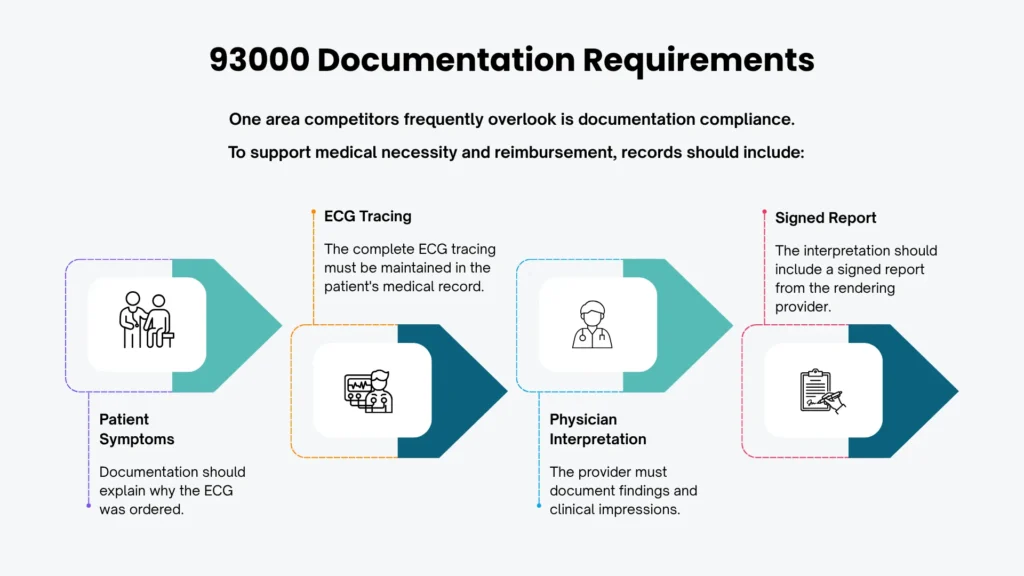
The patient’s medical record must clearly demonstrate the clinical reason for performing the test.
Accurate diagnosis-to-procedure mapping is essential, which is why many healthcare organizations rely on specialized medical coding services to support coding accuracy and compliance.
Related Diagnosis for CPT Code 93000
Selecting the proper diagnosis code is critical for reimbursement.
Common diagnoses associated with 93000 CPT code include:
- Chest pain (R07.9)
- Palpitations (R00.2)
- Essential hypertension (I10)
- Shortness of breath (R06.02)
- Syncope and collapse (R55)
- Cardiac arrhythmias
- Abnormal ECG findings
Payers expect diagnosis codes to support the medical necessity of the ECG service.
CPT 93000 Billing Guidelines
Following proper CPT 93000 billing guidelines helps reduce claim rejections and compliance risks.
Key requirements include:
- Documentation must support medical necessity.
- The ECG must contain at least 12 leads.
- Interpretation and report must be completed.
- Claims must follow payer-specific billing policies.
- Diagnosis codes must support the procedure.
Practices that perform high volumes of cardiac testing often utilize professional physician billing services to improve coding accuracy and ensure claims are submitted correctly.
Does CPT Code 93000 Need a Modifier?
In many cases, no modifier is required because 93000 already includes both the technical and professional components.
However, modifiers may be necessary under specific billing circumstances.
93000 CPT Code Modifier Options
Common modifiers include:
Modifier 26
Used when only the professional component is performed.
Modifier TC
Used when only the technical component is billed.
Modifier 59
May be appropriate when the ECG is a distinct procedural service and meets payer requirements.
CPT 93000 With Modifier 59
Many providers ask whether CPT 93000 with Modifier 59 can be billed.
The answer depends on the payer and clinical circumstances.
Modifier 59 should only be reported when documentation clearly demonstrates that the ECG service was separate and distinct from other procedures performed during the same encounter.
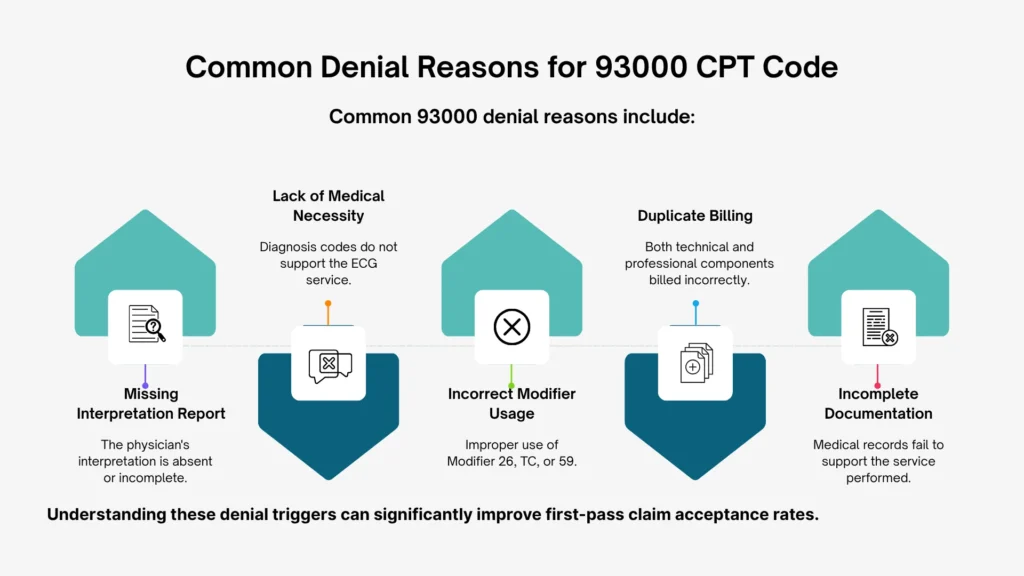
Improper use of Modifier 59 is a common cause of audits and denials.
CPT 93000 vs 93010 vs 93005
Understanding CPT 93000 vs 93010 is essential for accurate billing.
| CPT Code | Description |
| 93000 | Complete ECG including tracing, interpretation, and report |
| 93005 | Tracing only |
| 93010 | Interpretation and report only |
If another facility performs the tracing and the physician only interprets the results, 93010 may be appropriate instead of 93000.
93000 CPT Code Reimbursement
93000 CPT code reimbursement varies based on:
- Geographic region
- Medicare fee schedules
- Commercial payer contracts
- Facility setting
- Provider specialty
Providers should verify reimbursement rates annually because payment schedules can change.
Even properly submitted claims can experience payment delays. Effective A/R follow-up services help healthcare organizations identify unpaid claims, resolve denials, and accelerate collections.
Can We Bill CPT 93306 and 93000 Together?
Generally, yes.
CPT 93306 represents a complete transthoracic echocardiogram, while 93000 represents an ECG service.
Because these procedures evaluate different aspects of cardiac function, they are often separately billable when medically necessary and properly documented.
Providers should always verify payer-specific edits and bundling rules.
Can 99214 and 93000 Be Billed Together?
In many cases, yes.
An Evaluation and Management (E/M) service may be reported with 93000 when the E/M service is significant and separately identifiable.
Modifier 25 may be required on the E/M service depending on payer requirements.
Documentation should clearly support both services.
Can 93000 Be Billed Alone?
The answer is yes, provided:
- Medical necessity exists.
- Documentation is complete.
- Payer requirements are met.
- No bundling restrictions apply.
The ECG procedure does not require an accompanying office visit to be billable.
Best Practices for Maximizing Reimbursement
Healthcare organizations can improve reimbursement outcomes by:
- Conducting regular coding audits
- Verifying diagnosis-code linkage
- Monitoring payer updates
- Reviewing modifier usage
- Strengthening documentation standards
- Tracking denied claims proactively
Combining accurate coding with effective billing workflows can substantially improve revenue cycle performance.
Conclusion
Understanding the 93000 CPT code, its billing guidelines, reimbursement requirements, modifier usage, and documentation standards is essential for accurate claim submission and optimal reimbursement. Proper coding and thorough documentation can help healthcare providers reduce denials, maintain compliance, and improve revenue cycle performance.
At RevenueES, we support healthcare practices with expert medical billing services, medical coding services, physician billing services, and A/R follow-up services to help maximize collections and streamline the billing process. By partnering with an experienced revenue cycle management team, providers can focus on patient care while improving financial outcomes.